Drew Honeycutt
Architecture Comparison
Architecture
differences: Byzantine and Islam
Byzantine
and Islam architecture are alike and different in many ways. The best
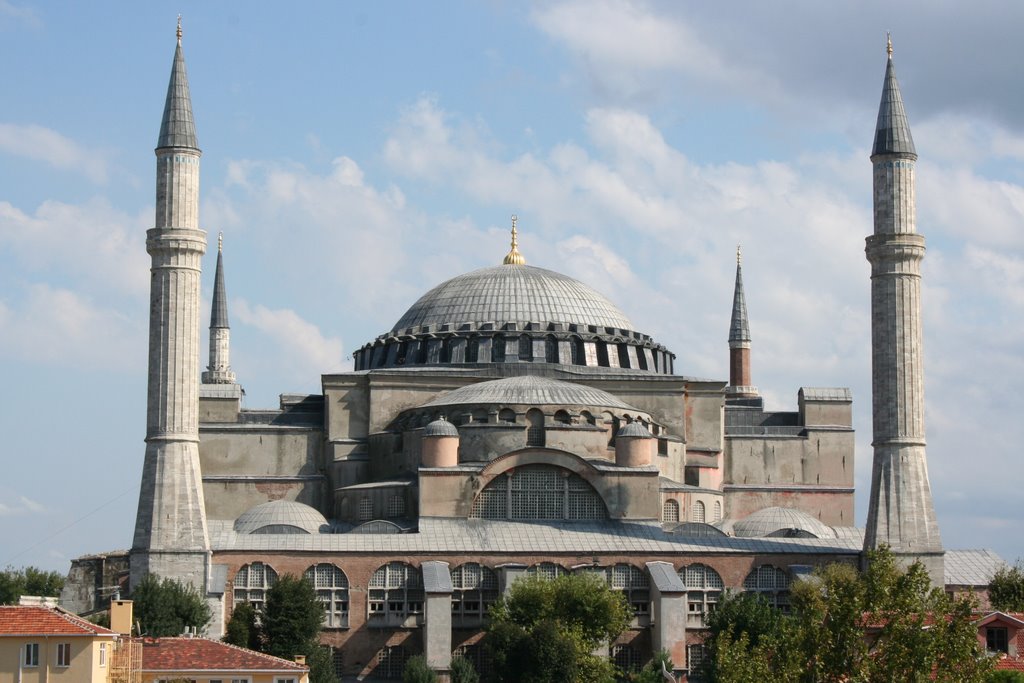
representation of Byzantine architecture is the beautiful Hagia Sophia. The
best representation of Islam architecture is The Great Mosque at Kairouan. These
two buildings are the best and most respected religious places of both
cultures. Islam and Byzantine architecture have similar techniques, but the two
have very different styles.
According
to the book “Byzantine Architecture” by Cyril Mango, architecture in Byzantium
was thought of as holy, but Byzantine architects do not create buildings the
same we do today. By today’s standards, Hagia Sophia, and assorted other
Byzantium buildings, should not have turned out as good as they did due to
their lack of math used in the making of it. Nevertheless the buildings turned
out beautiful, and highly respected. Hagia Sophia was so respected, it got its
name of Hagia Sophia which means “Holy wisdom. The Hagia Sophia is a very
colorful building. It had few columns for the time period and many elegant
arches. Hagia Sophia consists of one main building and smaller rooms. The base
of it is a circle, much like many other buildings in Byzantium. Other popular
shapes for bases of churches were squares of octagons. One of the reasons why
Hagia Sophia was so special to everyone is because of the stories that were
told in mosaics on the walls. Each wall told a different story. Decorations
were everywhere, Hagia Sophia was a beautiful ingenious masterpiece for the
times. The lighting in Hagia Sophia was all because of the clerestories. A
clerestory is a decorated window that usually is above the choir, sides, and
above the nave (The entrance of a church or religious place). The whole
building was surrounded by Syrian towers that were extravagantly decorated. Everything
on Hagia Sophia was gorgeous, but the crowning jewel was its 102 ft. 6 in.
dome. The idea of the dome came from the Persians and was used in many
Byzantium buildings. The domes usually were made of bricks and mortar. Some
buildings even had more than one dome. Byzantium Architecture was thought of as
the most beautiful, and Hagia Sophia was the most beautiful of all the
Byzantium buildings.


According
to the book “Byzantine Architecture” By Cyril Mango, the Great Mosque of
Kairouan is a highly respected religious building to the Islam community. Islam
architecture is symbolic and has a clever arrangement. The buildings of the
Islam were usually only one color, and that color was a sandy, tan color. This
was due to the lack of many colors around at the time. These religious places
usually had a large courtyard and were usually flat with a square base. This
large courtyard was because there were many participants. In the center of
these courtyards was some sort of, either, fountain or pier. The Great Mosque
of Kairouan had many columns and arches. Sometimes, on these columns, there
would be facades. A façade is a carving of a face. The Islam people did not
fear the usage of icons or representations of gods, people, or anything. From
the database, “Muslimheritage.com”, they also enjoyed the usage of wood
carvings. They would mainly carve into chairs. These chairs were usually used
for priests. The most special chair was for the high priest. The high priests
chair would usually be made of 300 pieces of Indian teak. The Muslims took a
lot of influence from other cultures too. They used something called “Moorish”
Architecture. They used crenellations that were to imitate those of the Tulun’s
mosque in Cairo Egypt. But besides these ideas used, Islam Architecture had its
own style. According to the Museum with no Frontiers Database, one of the most
important distinctions between Islam and Byzantine architecture is that Islam religious
buildings require a mihrab. A mihrab is a little niche in a wall or special
door that faces toward Mecca. In the Islam churches, everyone believed that
they had to pray towards Mecca because of Mohammed’s teachings. So the Niche in
the wall is the direction that the congregation prays towards. The Mihrab
itself was not very extravagant, but the qibla was highly decorated. The qibla
was the wall that had the mihrab. The wall itself would have stories upon
stories in pictures made of mosaics. The Islam culture has a very fascinating,
symbolic religion and architecture that is alike Byzantine architecture in some
ways, and different in others. But there is no doubt, that both of these
different styles are beautiful and creative. While they may be older buildings,
they will never be forgotten.
http://d1ezg6ep0f8pmf.cloudfront.net/images/lthumbs/a4/20174-great-mosque-kairouan.jpg

Concluding statement: Throughout the usage of Domes, color, style, size, and layout, Byzantine and Islamic architecture have similar threads. But they also have different types of architecture. Islam and Byzantine architecture have similar techniques, but the two have very different styles.
Outline/ Notes:
MAJOR POINT: Dome of the rock, this was a happy medium
between islam and byzantine architecture. Use of dome… Similar dome styles…
DOTR was Islamic with byzantine influence…
Islam Architecture:
·
Fresco Paintings
GREAT MOSQUE OF KAIROUAN “The Great Mosque at Kairouan represents one of the most prestigious places
of worship in Islam.”
·
o
Qibla- highly decorated
(This is the wall that has the mihrab)
o
Mihrab
o
There was always a chair
for the highest priest.
§
This chair was usually
wooden and highly decorated and carved
§
Made of 300 pieces of
Indian teak
§
The carving combines
byzantine and Mesopotamian
§
Fluted dome over narthex
(Main entrance) and its opposite the main altar
§
Syrian towers
surrounding
§
Buttresses for support
·
Crenellated roof (these crenellations were to
imitate those of the Tulums mosque)
·
Sculptured stone reliefs
·
Roman lighthouses
·
Syrian Towers
·
delicately carved stone facade (Face
carving)
·
Had something called “Moorish” Architecture
·
Flat
·
Colorless
·
The Great Mosque at Al Qayrawan in Tunisia—Many
columns
·
http://classconnection.s3.amazonaws.com/206/flashcards/34206/jpg/sousse-tunisia.jpg
·
Luster tile decorations
·
Al hakim
·
http://www.beautifulmosque.com/wp-content/uploads/2013/07/al-hakim-mosque-in-cairo-egypt-13.jpg
·
the Great Mosque at Córdoba
·
Alternating red or black and white tiles to
cover arches
·
Stone and wood were but ornaments to their
palaces. Wooden boxes remain today
·
Boxes and chairs were also made of precious
metals
·
Used domes- common thread
·
A key difference is that all religious places
would have a Mihrab (a niche in the wall that faces toward Mecca so people know
which direction to pray)
·
Large open areas in the middle (with the
exception of a fountain and our small pier) so many people can come in and pray
·
Common themes
o
One color (Sandy)
o
Spiral towers
o
Patterns
o
Carved stories into rock
o
Small poles on top of domes
o
Domes –Smoothed out
o
Carved statues
Byzantine Architecture
·
Colorful
·
Fewer columns
·
Hagia Sophia- Beautiful! “Holy wisdom”
o
Baths,
aqueducts, law courts, hospitals, schools
·
In architecture, “basilica” in its earliest
usage designated any number of large roofed public buildings in ancient Rome
and pre-Christian Italy, markets, courthouses, covered promenades, and meeting
halls.
·
Symmetrical rome designs
·
To allow a dome to rest above a square base,
either of two devices was used: the squinch (an arch in each of the corners of
a square base that transforms it into an octagon) or the pendetive.
Byzantine structures featured soaring spaces and sumptuous decoration: marble
columns and inlay, mosaics on the vaults, inlaid-stone pavements, and sometimes
gold coffered ceilings.
·
Mini domes and one big dome
·
Buttresses
·
Popular building shapes were pentagons and
squares
·
Their architecture plans were sloppy and
unbelievable. Some buildingd is the impossible building because of the
octagonal shape, its non symmetrical
placement
·
Hagia Sophia-
o
One big room along with many other smaller rooms
o
Got the dome idea from Persians really “Persian
Dome”
·
Common themes
o
Domes
o
Arches
o
Circular buildings
o
Octagonal
o
Walls tell a story
o
Mosaics
o
Multi colors
o
Clerestories (the upper part of the nave, choir,
and transepts of a large church, containing a series of windows. It is clear of
the roofs of the aisles and admits light to the central parts of the building.)
Citations:
- “The Byzantine Empire” Roger B. Beck, . <http://my.hrw.com/tabnav/controller.jsp?isbn=9780547521084>.
- “Byzantine Architecture” Anthony, Rashan, William, . N.p.. Web. 13 Dec 2013. <http://library.thinkquest.org/C005594/Medieval/byzantine.htm>.
- Mango, Cyril A. “Byzantine Architecture.” New York: H.N. Abrams, 1976. Print.
- Mohamed Béji Ben Mami "Great Mosque of Kairouan" in Discover Islamic Art. Place: Museum With No Frontiers, 2013
- Ben Mama, Mohamed Beji. "Great Mosque of Kairouan." Www.DiscoverIslamicart.org. MWNF, 2004. Web. 16 Dec. 2013. <http://www.discoverislamicart.org/database_item.php?id=monument;ISL;tn;Mon01;2;en>.
Hyperlinks:
http://my.hrw.com/tabnav/controller.jsp?isbn=9780547521084

No comments:
Post a Comment